
Why Cold-Pressed Argan Oil Is Superior – And How to Spot the Real Thing
Walk into any beauty aisle and you’ll find dozens of products claiming to contain argan oil. From budget shampoos to luxury serums, “argan oil” appears on labels everywhere. But here’s something most brands won’t tell you: the quality of argan oil varies enormously depending on how it was extracted, processed, and stored.
The difference between cold-pressed organic argan oil and its refined, processed counterpart is not a minor technicality – it’s the difference between an oil that genuinely transforms your skin and one that merely moisturises it a little.
This guide explains exactly what cold-pressing means, why it preserves nutrients that other methods destroy, and – crucially – how you can spot real, high-quality argan oil when shopping online or in store.
What Does ‘Cold-Pressed’ Actually Mean?
Cold-pressing is a mechanical extraction method that uses pressure rather than heat or chemical solvents to extract oil from plant seeds or kernels. In the case of argan oil, the kernels inside the argan fruit’s hard shell are removed, dried, and then pressed at temperatures kept below around 49°C (120°F).
This low-temperature process is critical because many of argan oil’s most beneficial compounds – particularly Vitamin E (tocopherols), polyphenols, and essential fatty acids – are heat-sensitive. Expose them to high temperatures and they begin to degrade. Use chemical solvents and you risk residue contamination as well as nutrient loss.
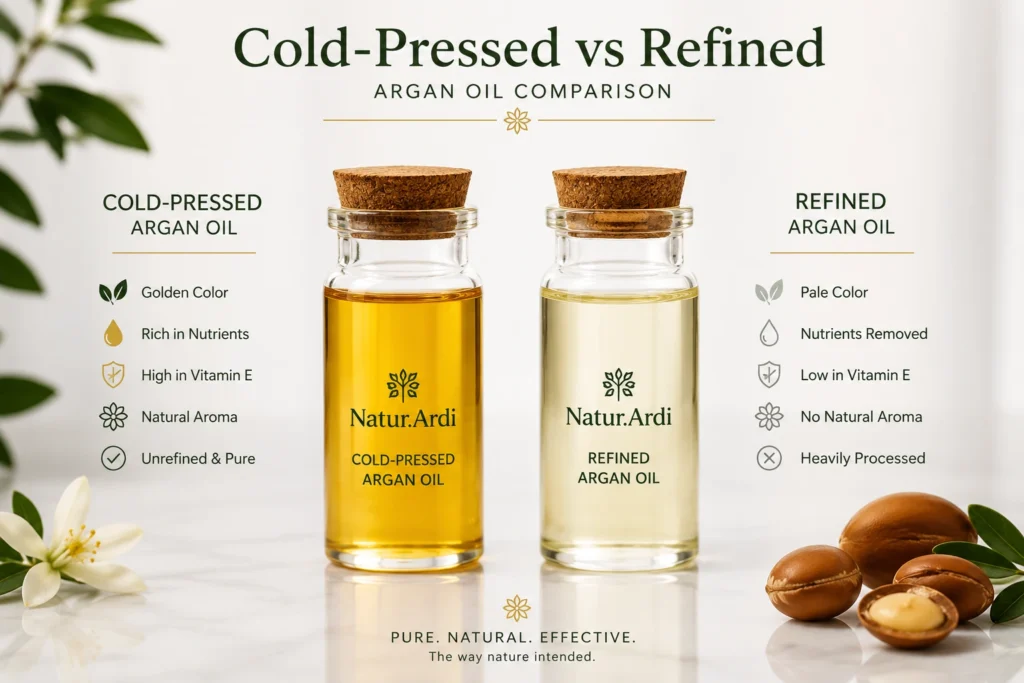
Cold-pressed argan oil is typically golden-amber in colour and has a subtle, nutty scent. These are not imperfections – they’re signs that the oil has been minimally processed and retains its full natural profile.
Staff picks
How Refined Argan Oil Differs (And Why It Falls Short)
Refined argan oil undergoes additional processing steps – typically including deodorisation (removing the natural scent using heat or steam), bleaching (removing the natural colour using clay or chemicals), and filtration. The result is a pale, odourless oil that looks clean and neutral.
The problem is that these processes don’t just remove smell and colour – they strip out much of the nutritional value too. Studies comparing cold-pressed and refined argan oils consistently show significantly higher levels of tocopherols (Vitamin E) and polyphenolic antioxidants in cold-pressed versions. Refined argan oil is cheaper to produce and easier to incorporate into mass-market formulations, but it’s a far weaker ingredient in terms of actual skin benefit.
When you see “argan oil” listed mid-label in a £5 shampoo, it’s almost certainly a refined fraction – present in trace quantities and included for marketing purposes rather than functional effect.
The Nutrient Profile of Real Cold-Pressed Argan Oil
Understanding what makes cold-pressed argan oil special starts with its chemistry. Genuine cold-pressed argan oil is rich in:
Oleic acid (omega-9): A moisturising fatty acid that softens skin and helps other active ingredients penetrate deeper. It makes up around 43–49% of argan oil’s fatty acid profile.
Linoleic acid (omega-6): Essential for maintaining the skin’s lipid barrier. Linoleic acid deficiency is linked to dry, rough, and acne-prone skin. Argan oil is rich in it.
Vitamin E (tocopherols): One of skin’s most important antioxidants. Vitamin E neutralises free radicals from UV exposure and pollution, protects cell membranes, and supports healing. Cold-pressed argan oil contains substantially higher Vitamin E levels than refined versions.
Polyphenols: Plant compounds with antioxidant and anti-inflammatory properties. Research suggests they play a role in protecting skin against UV-induced damage and reducing signs of ageing.
Squalene: A natural skin-identical lipid that mimics the skin’s own sebum, providing immediate comfort and softening without clogging pores.
How to Identify High-Quality Cold-Pressed Argan Oil
Check the Ingredient Label
The INCI (International Nomenclature of Cosmetic Ingredients) name for argan oil is Argania Spinosa Kernel Oil. On a pure argan oil product, this should be the only ingredient (or the first ingredient, if additional natural extracts are included). If you see it listed after water, glycerin, and a list of other ingredients, you’re looking at a diluted formulation.
Look for ‘Cold-Pressed’ and ‘Organic’ on the Label
Legitimate certifications and clear labelling are your best friends. Look for “cold-pressed” or “cold-extracted” on the label. An organic certification means the argan kernels were grown without synthetic pesticides or fertilisers, which matters both for your skin and for ethical sourcing.
Assess the Colour and Scent
Genuine cold-pressed argan oil has a warm golden to amber colour and a faint, pleasant nutty scent. If an argan oil is completely colourless and odourless, it has almost certainly been refined and deodorised – and you’re losing much of its nutritional value in the process.
Consider the Packaging
Light degrades the antioxidants in argan oil over time. Quality argan oil is typically packaged in dark glass bottles that protect the contents. Plastic bottles or clear glass packaging is a red flag for a product where the manufacturer isn’t particularly concerned about preserving efficacy.
Evaluate the Price Point
Genuine, certified organic, cold-pressed argan oil is not cheap to produce. The argan tree grows almost exclusively in a specific region of Morocco, the kernels must be harvested and processed with care, and certification adds further cost. If an “argan oil” product is very cheap, ask yourself what shortcuts have been taken.
Why Moroccan Origin Matters
The argan tree (Argania spinosa) is a protected species that grows almost exclusively in the UNESCO-recognised Arganerais Biosphere Reserve in southwestern Morocco. Argan oil sourced directly from this region, processed by Moroccan cooperatives (many of which are women-led), is not just higher in quality – it supports sustainable livelihoods and helps protect an endangered ecosystem.
Natur.ardi sources its argan oil directly from certified Moroccan producers, ensuring both the quality of the final product and the integrity of the supply chain.
FAQ: Cold-Pressed Argan Oil
Q: Is there a significant difference between cold-pressed and regular argan oil on the skin?
A: Yes. Cold-pressed argan oil retains significantly higher levels of Vitamin E and polyphenolic antioxidants, which are the compounds most responsible for its anti-ageing and skin-nourishing effects.
Q: Does cold-pressed argan oil have a strong smell?
A: It has a mild, pleasant nutty scent that most people find unobtrusive. When infused with natural fragrance such as orange blossom, the scent is masked while the beneficial properties are preserved.
Q: Can I use cold-pressed argan oil on oily skin?
A: Yes. Argan oil is non-comedogenic, meaning it does not clog pores. Its linoleic acid content may actually help balance sebum production over time.
Q: How should I store cold-pressed argan oil?
A: Store in a cool, dark place away from direct sunlight. A cupboard or drawer is ideal. Avoid leaving it on a sunny windowsill, as UV exposure degrades the antioxidants.
Conclusion: Choose Your Argan Oil With Care
Not all argan oils are created equal – and now you know exactly how to tell the difference. When you invest in certified organic, cold-pressed argan oil from a traceable Moroccan source, you’re not just buying a moisturiser. You’re buying a concentrated dose of one of nature’s most effective skincare ingredients, in its purest and most potent form. Natur.ardi’s Golden Neroli Argan Oil uses only certified organic, cold-pressed Argania Spinosa Kernel Oil, infused with natural orange blossom. No refinement, no dilution – just liquid gold in its best possible form. Try it today and feel the difference that genuine quality makes.