Nila vs Clay Mask: Which Is Better for Oily Skin?
If your skin leans oily, produces excess shine by midday, or struggles with congested pores, you’ve almost certainly reached for a clay mask at some point. Clay masks have dominated the oily skin market for decades – and for good reason. But there’s an ancient Moroccan contender that many people with oily skin haven’t yet considered: nila.
Nila – a traditional plant-based indigo powder used in Moroccan beauty for generations – offers a different but equally compelling approach to managing excess sebum, congested pores, and uneven skin texture. In some respects it outperforms clay; in others, clay has the edge.
This honest comparison looks at both ingredients side by side, so you can decide which belongs in your routine – or whether the answer is actually both.
Understanding Oily Skin: What’s Actually Happening
Before comparing treatments, it helps to understand the mechanism. Oily skin is characterised by overactive sebaceous glands that produce more sebum than the skin needs for protection and moisture. This excess oil sits on the surface, attracting pollution particles and dead skin cells, which then accumulate in the pores. The result is shine, congestion, blackheads, and – for many people – a cycle of breakouts.
Effective treatments for oily skin need to achieve at least one of the following: absorb excess sebum from the surface, unclog pores, reduce the overproduction of sebum at the gland level, or minimise the appearance of enlarged pores. Both clay and nila address several of these goals, but through different mechanisms.
Clay Mask: The Well-Established Option
How Clay Masks Work
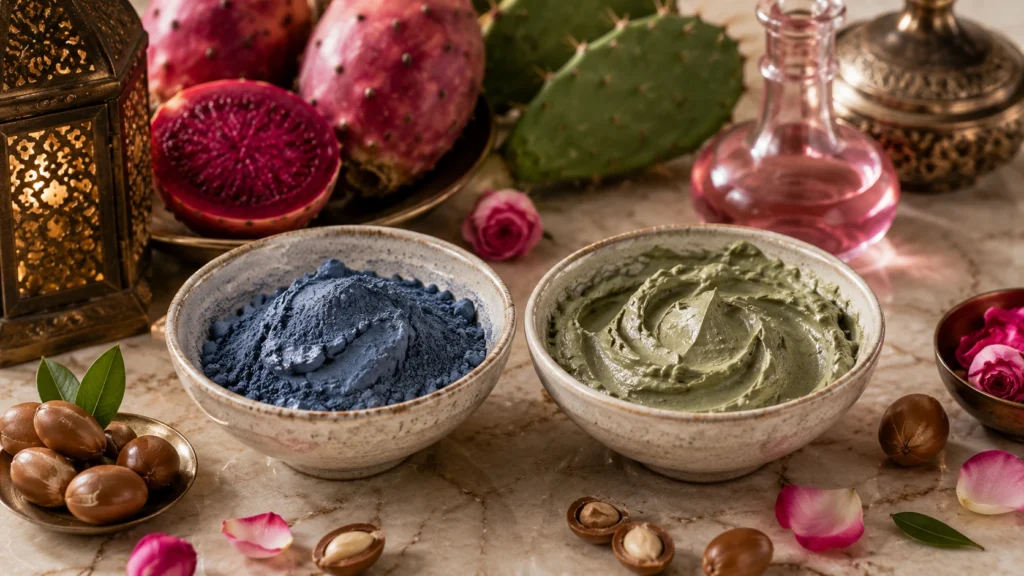
Clay masks – whether kaolin, bentonite, rhassoul, or green clay – work primarily through adsorption. The clay mineral structure carries a natural negative charge, which attracts the positively charged ions in sebum and other impurities, drawing them out of the pores and binding them to the clay as it dries on the face.
Rhassoul clay and Moroccan green clay are particularly fine-grained and rich in minerals including silica, magnesium, calcium, and potassium, making them excellent for absorbing excess oil without over-drying the skin.
The Strengths of Clay Masks
Clay masks have a substantial evidence base, both clinically and anecdotally. They are excellent at mattifying the skin, visibly reducing shine within minutes of application. They are well tolerated by most oily and combination skin types and are widely available at various price points.
Moroccan rhassoul clay in particular has mild exfoliating properties and leaves the skin feeling genuinely clean and smooth after rinsing.
The Limitations of Clay Masks
The main limitation of clay masks is the risk of over-drying. Particularly with kaolin and bentonite formulations, leaving a clay mask on too long can strip not just excess oil but also the skin’s essential lipid barrier, triggering a rebound effect where the skin produces even more sebum to compensate. This is why clay masks should typically be rinsed before they fully dry on the face.
Clay masks also don’t offer much beyond sebum absorption – they lack the brightening, antioxidant, or skin-tone-evening properties that some people with oily skin also need.
Nila Mask: The Moroccan Alternative
How Nila Works
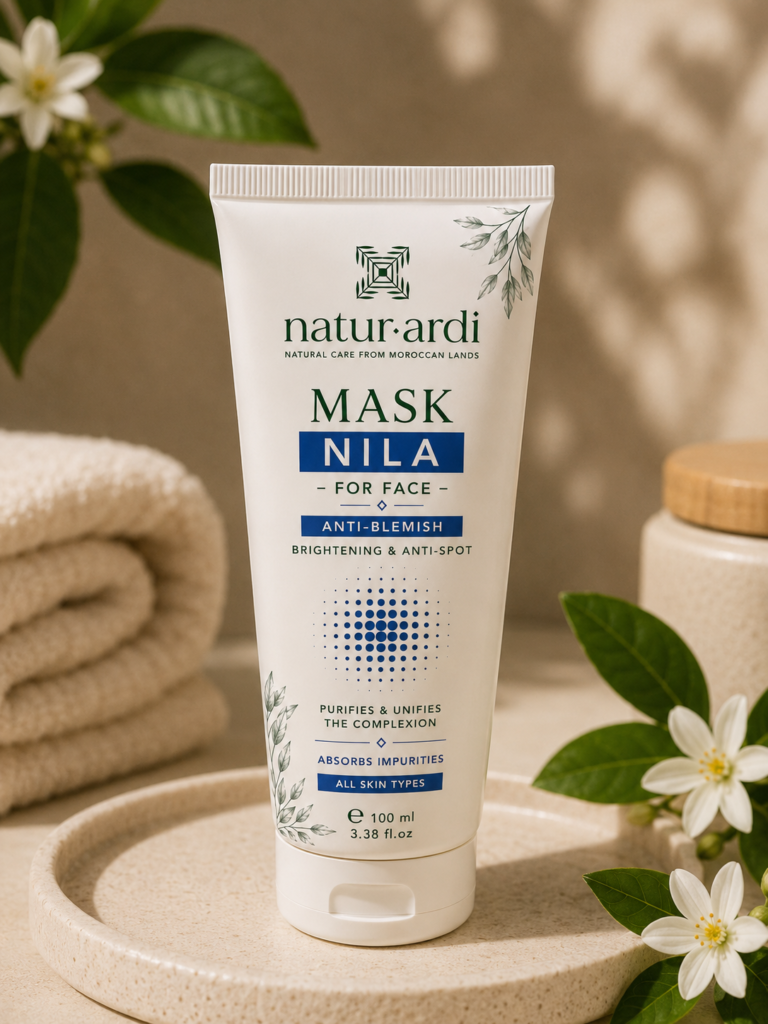
Nila works through a different set of mechanisms. Its natural astringent properties help tighten the skin’s surface, visibly minimising pores and reducing excess oil. Its traditionally antiseptic properties help keep the skin surface clean. Unlike clay, nila is used as a paste mixed with liquid rather than a dry powder, which means it doesn’t over-dry the skin in the same way.
The natural indigo compounds in nila also contribute antioxidant and anti-inflammatory activity, addressing not just the oiliness itself but also the redness, irritation, and oxidative stress that often accompany congested skin.
The Strengths of Nila Masks
Nila brings several unique advantages. Its ability to brighten and even skin tone over time is particularly valued – oily skin often displays hyperpigmentation or post-blemish marks that a clay mask alone won’t address. Its anti-inflammatory properties make it gentler on reactive or irritated skin than some clay formulations. And its rich cultural heritage means it comes with centuries of real-world validation.
For people who find clay masks too drying but still need a weekly deep treatment, nila often strikes the right balance.
The Limitations of Nila Masks
Nila is less widely understood than clay, which means fewer comparative studies exist. Its oil-absorbing capacity, while effective, is generally considered less dramatically sebum-removing than a strong bentonite clay mask. Those seeking maximum immediate mattification may prefer clay for that specific purpose.
Head-to-Head Comparison
Sebum absorption: Clay wins for immediate, dramatic oil removal. Nila is effective but more balanced.
Brightening and skin tone: Nila has the clear advantage here. Clay offers little in this department.
Pore appearance: Both reduce pore visibility, through different mechanisms (adsorption vs astringency).
Gentleness: Nila is generally gentler and less likely to over-dry. Clay requires careful timing to avoid this.
Anti-inflammatory: Nila has the advantage, particularly for reactive or post-breakout skin.
Evidence base: Clay has more published clinical data; nila is supported by extensive traditional evidence.
Best for: Clay is best for maximum oil control. Nila is best for congestion, brightening, and sensitive oily skin.
The Verdict: Why Choose When You Can Use Both?
The most effective approach for many people with oily or combination skin is to alternate between the two depending on what your skin needs in a given week. Use a nila mask when you want to brighten, balance, and soothe. Reach for clay when excess oil and visible congestion are your primary concern.
Using both weekly (alternating rather than simultaneously) gives your skin the full benefit of two complementary deep-treatment traditions.
FAQ: Nila vs Clay for Oily Skin
Q: Can I use both a nila mask and a clay mask in the same week?
A: Yes, but alternate rather than combine. Use one on Monday and the other on Thursday, for example. Over-masking can compromise the skin barrier even with gentle formulations.
Q: Which mask is better for acne-prone skin specifically?
A: Nila’s anti-inflammatory properties make it well suited to inflamed, acne-prone skin. Clay is better for the blackhead-and-congestion type of acne rather than inflammatory breakouts.
Q: Do I need to moisturise after a nila mask?
A: Yes – always follow any mask with a moisturiser. Even for oily skin, a lightweight, oil-free moisturiser helps restore the skin’s barrier and prevents the rebound oil production triggered by dehydration.
Q: How often should I use a nila mask for oily skin?
A: One to two times per week is generally sufficient. More frequent use is unlikely to provide additional benefit and may cause unnecessary drying.
Conclusion: Give Nila the Recognition It Deserves
Clay masks have earned their place in every oily-skin sufferer’s cabinet. But if you’ve been loyal to clay without ever trying nila, you’re missing a treatment that has been delivering clear, bright, balanced skin in Morocco for centuries – and is only now finding the global audience it deserves.
Try Natur.ardi’s Nila Face Mask and experience the difference for yourself. Your skin will thank you for expanding its horizons.